Sunday, June 28, 2015

California Nights: Best Coast Come Home

There is nothing quite like a hometown, tour-ending show. And there is nothing quite like Best Coast.

In the studio, they are essentially Bethany Cosentino (who does all of the songwriting) and multi-instrumentalist Bobb Bruno. However, Bruno can hardly play guitar, bass, and drums simultaneously onstage, so they tour with an augmented lineup—sort of like the Genesis of their own one-band genre.

Like many successes, that genre is a synthesis: of surf music, girl groups, the American Graffiti soundtrack (not limited to its surf music and girl groups), and whatever is salvageable from post-Eighties “alternative” music.

The touring lineup pulled into The Wiltern in Los Angeles last night to end their latest tour, one in support of their new album California Nights (Harvest). The now-seatless Wiltern was overflowing with a literally standing-room-only crowd. The crowd’s enthusiasm was obviously reciprocal and ensured the tour closer was almost everything a hometown tour closer should be. The multi-generational audience was indicative of the band’s influences and quality.

Cosentino, a Glendale, Los Angeles County native, spent a miserable freshman year at a Brooklyn college several years ago. Suffering from her first winter weather season and seasonal affective disorder, she dropped out and returned to her meteorologically comfortable home. She wrote a series of open love letters to her home state and teamed with Bruno, a veteran of the Los Angeles “indie” music scene. (You may notice that she shares her initials with those of her band name.) The fiercely independent songwriter rejected major label deals, and the two have released three LPs and several singles/EPs. (The new album was offered as a package deal in digital download form with the purchase of a concert ticket, in harmony with the theme of this weblog, but this band sounds most gloriously crisp and organic on vinyl, on which format all of the releases are also available.)

Cosentino’s songs are simple and can be repetitive musically and lyrically (she essentially writes two kinds of songs—open love letters to the once-Golden State, still golden in her mind, and love letters of sorts about less-than-entirely-functional human relationships). On stage, they could benefit from a little more spontaneity and variety (something else they share with Genesis despite their decidedly non-prog, “indie” roots). Leaving aside those caveats, they are required listening (and viewing) in a moribund culture of baby boomer nostalgia shows and American glorified karaoke idol/America’s Got Ballast shlock simulacra.

Bully opened. Their frontwoman’s voice (when it wasn’t screaming) sounded like a raspier, flatter version of Sophie B. Hawkins’s, which was pleasant enough (and by far the highlight of their performance). In the interest of space (and the “if you have nothing [else] nice to say” cliché), I won’t opine further (except to note that their interminable thirty-one minute set felt like an hour and thirty-one minutes).

At 10:16 PM PDT, after a heterogeneous selection of pre-show music from girl groups to metal, the houselights were lowered again on a stage that was backed by a wide projection screen over the drum riser. A video show began while a speed metal song played in the background and the five players took the stage. The blurred, out-of-focus images of palm trees, waves, and other local images continued throughout the tight and tightly-executed eighty-minute set. Perhaps they brought necessary subtle visual augmentation during gigs away from the “best coast”. They seemed superfluous though not distracting on the corner of Wilshire Boulevard and Western Avenue.

The set commenced with the title track from 2012’s The Only Place (Mexican Summer), and the paean to the left coast works well as an opener on record and stage. I think new member Joe Bautista played a few lead licks on this one, but he played competent, supportive rhythm guitar (and occasional keyboards) for the rest of the set. (According to Wikipedia, the touring lineup is Cosentino, Bruno, Bautista, and the now-veteran rhythm section of bassist/background vocalist Brett Mielke and drummer Brady Miller. If so, I am confused by the “CC” on Miller’s bass drum head. If any of this information is inaccurate, blame Wikipedia—and the paucity of information about the touring lineup on the band’s official website and Facebook pages.) The five professionally played a lineup of songs similar to the other shows on the tour with a cohesive integration and competent professionalism lacking in so many artists these dark days, especially among bands of their provenance and sensibilities. This band has matured and strengthened since their last appearance at the Wiltern three years ago. Cosentino (self-described as awkward in the past) is considerably more socially deft and confident now, and her voice, which used to falter and frequently fall flat, consistently soars now. Billy Joel once referred to the concert stage as a crucible, and the results of these five’s determined art substantiate his idea. Dave Marsh once opined that those who make the best records don’t always (or even often) make the best shows. Although he had a point, Best Coast (touring edition) is a reminder that there are exceptions (or partial exceptions).

It is impossible to succinctly describe a Best Coast live performance; one really has to be there. Cosentino frequently strums rhythm guitar, but many of the highlights of the show occurred when she put it down and concentrated on her vocals. The new album’s title track was one of them—it’s a twist on the band’s local pride tinged with ennui. Bautista’s rarely-used keyboard was effective on it. Cosentino picked up a tambourine for another highlight, “Dreaming My Life Away”, which departed from the studio recording (from The Only Place) in subtle and unsubtle ways in which many of the other songs did not. The bouncy “When I’m With You”, which preceded it, provided an instructive example of what Frank Zappa called contrast and relief in a stage setting, something this band (at least instinctively) understands. Cosentino picked up her Fender Stratocaster for “Feeling OK”, the opening track of California Nights and one of the reflective album’s more sanguine songs. Bruno never takes a solo per se, but his performance was essentially one long basic but effective Sixties-style guitar solo of reverb-drenched lead lines. (Unfortunately, he occasionally devolves into anti-musical modernist noise, but it’s rare enough that it doesn’t significantly detract from the live show’s value.)

The main set closed (as usual recently) with “When Will I Change” (which is more congruent with the darker tone of the new album and the darker side of the once-Golden State). The band left the stage without a goodbye (though the song of that name was played much earlier in the set), and returned to deliver the typical two-song encore. The first was apparently Oasis’s “The Hindu Times”. Prefacing the band’s breakthrough single (still their best-known song), “Boyfriend”, Cosentino couldn’t avoid praising Friday’s Supreme Court decision for what she noted was the second consecutive evening. “Boyfriend” is a wonderful song, but it works slightly better in the studio and is an anti-climatic regular finale. It was even more anti-climatic in the context of last night. Ironically, “Boyfriend” has a drum introduction that sounds similar to Max Weinberg’s opening fusillade in Bruce Springsteen’s “Badlands”. Springsteen, who uniquely spices each set from coast to coast and beyond, still has more to teach them.  “Boyfriend” (and the show) ended with a minute or two of Bruno and Bautista, by then alone on stage, making modernist noise and feedback to no discernible good end. It was an incongruous, anti-music end to an otherwise stellar, melodious evening.

  This band still has a few weaknesses, but the band keeps getting better. And they were unusually mellifluous and instrumentally tight to begin with. Best Coast is a welcome antidote to much of the malaise and schlock of a culture in serious trouble of entropic disintegration. Rock is a dying art form, for better or for worse, and live music is not far behind (for worse). That’s easy to forget when listening to Best Coast. You should see them.


Best Coast
The Wiltern
Los Angeles
Saturday, June 27, 2015
Spring/Summer 2015 Tour (for California Nights)
Support: Bully

Set:
The Only Place
Heaven Sent
Fine Without You
Goodbye
Do You Love Me Like You Used To
Crazy for You
No One Like You
So Unaware
California Nights
When I'm With You
I Don't Know How
Dreaming My Life Away
Fade Away
Fading Fast
In My Eyes
Feeling Ok
Our Deal
Jealousy
When Will I Change

The Hindu Times
Boyfriend


The Wiltern stage before the show. Those at the front must have been able to read the setlist hanging from the keyboard, spoiling any surprises.

The live band.

A provocatively-dressed Cosentino (who commented that she would never wear that anywhere but her hometown) singing "Dreaming My Life Away".

Thanks to the two congenial young ladies who graciously allowed me to photograph this outside after the show. 


Monday, March 30, 2015

Update

http://www.parcbench.com/2015/03/18/southside-johnny-plays-rarities-and-springsteen-songs/

A revised and expanded version of my review of Southside Johnny and the Asbury Jukes's two recent concerts was published on ParcBench on March 18 (see above link).  Thanks (again) to Gregory Zeigerson and ParcBench.

Sunday, March 1, 2015

Southside Johnny and the Asbury Jukes Come Home Again

The first night was not even sold out.

Southside Johnny and the Asbury Jukes ended a two-night stand at their famous birthplace, The Stone Pony, last night.  Friday night’s show was advertised as “Rare Jukes: All the Non-Hits, All the Time” (even though they did not have a hit).  Saturday night’s show was advertised as “Prove It All Night: The Music of Bruce Springsteen.”  At least Saturday sold out well in advance (prompting the venue to issue a disclaimer to the overwhelming response that no tickets would be released and that no one but Southside Johnny and the Asbury Jukes would be there), but that might have had as much to do with the songwriter of most of that night’s songs as much as the artist.

Anyway, Southside Johnny and the Asbury Jukes can apparently no longer sell out an evening full of rarities at The Stone Pony on a Friday evening with relatively reasonable ticket prices (a special two-day “VIP” pass was available).  There is little (if any) causal relationship between this fact and the quality of their current performances, and I doubt there is much of a causal relationship between the absence of all of the members of their classic lineup and the available tickets.  It’s the Endarkenment.
As their fans (and anyone else who appreciates extemporaneous, colorful, melodic, and skillful live music) know, Uncle South and company are a cultural treasure for any fan of modern popular music.  As I’ve previously written, they may be the greatest bar band (that is saying something, and that is a compliment).  Their typical repertoire is a diverse array of classic R&B and rock & roll covers, early songs written by Bruce Springsteen and/or founding member Steve Van Zandt, and more recent songs written by the man legally known as John Lyon and others (usually longtime Jukes keyboardist/vocalist Jeff Kazee).  Obviously, this weekend’s shows had little of the typical repertoire (Southside thinks that calling them “concerts” is too high-falutin’), but a few welcome regulars showed up among the long-unplayed (and, in a few cases, probably never-played) rarities.
There were no openers.  The doors opened at 7 PM on freezing winter evenings, and a legendary New Jersey shore disc jockey (whose name I cannot recall) played geographically appropriate tunes (including Bon Jovi, John Eddie, and John Cafferty and the Beaver Brown Band).  The club’s walls are still festooned with posters of past events and autographed guitars (I saw one the stupendous and unsung Jesse Malin left behind with his trademark slogan “P.M.A.”—positive mental attitude—from a 2007 performance I attended).  The club, which opened in March 1974, was concluding its 40th anniversary festivities (and was still selling related T-shirts).

Around 8:57 PM Eastern Standard Time on Friday, the great-uncle of the dwindling local music scene and his current sidemen entered through the side-stage door from the dark, frigid shore night.  Some of the most beloved long-time Jukes have long left for presumably higher-paying jobs, musical and otherwise.  Guitarist and songwriter Billy Rush is reportedly selling cars in Florida. Drummer and vocalist Kenny “Popeye” Pentifallo and keyboardist Kevin Kavanaugh surfaced on their annual Fourth of July weekend concert on July 3, 2008 in two of the local opening acts.  Pentifallo came across as a semi-retired musician who prospered in another line of work, and the youthful-looking Kavanaugh has since died young.  Baritone saxophonist Eddie Manion now works with a more famous New Jersey musical boss.  Trombonist and vocalist Richie “La Bamba” Rosenberg and trumpeter and vocalist Mark “The Love Man” Pender moved to Los Angeles with Conan O’Brien (I don’t watch television, but one can apparently still see them on O’Brien’s TBS show).  Guitarist and songwriter Bobby Bandiera tours with a band called Bon Jovi, but he still occasionally shows up with his erstwhile band the Asbury Jukes (especially in the studio).  The ever-evolving Asbury Jukes lineup on Friday night consisted of Kazee, Tom Seguso on drums, John Conte on bass guitar, Glenn Alexander on guitar, Neal Pawley on trombone and acoustic guitar, Chris Anderson on trumpet, Doug DeHays on saxophones, and Doug DeHays on tenor and baritone saxophones.
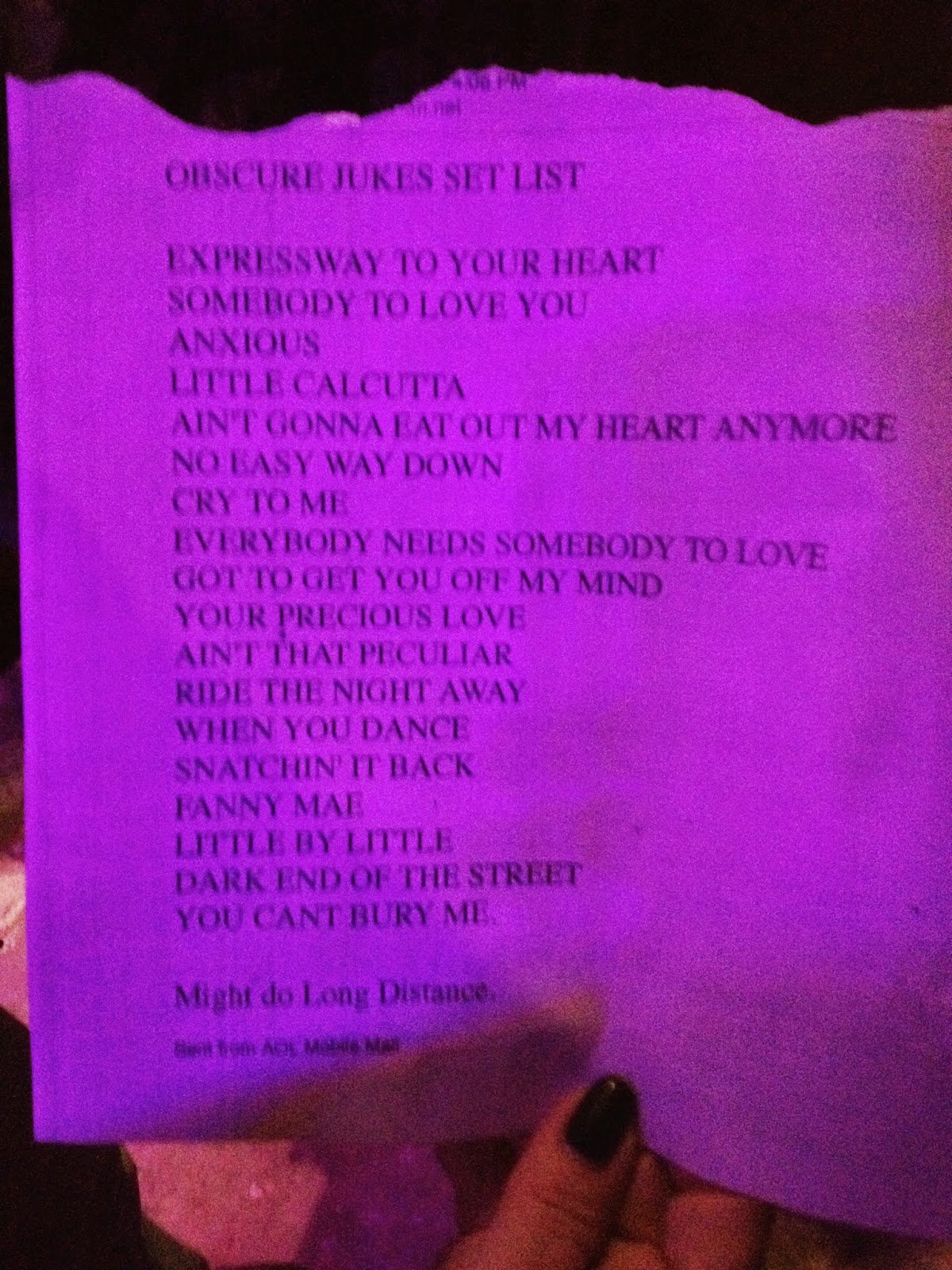
DeHays started the festivities with an unplanned (or, at least, unsetlisted) rendition of the Star Trek theme (presumably inspired by Leonard Nimoy’s death).  It reminded this unfamiliar observer of “The Christmas Song” and more or less segued into The Soul Survivors’ “Expressway to Your Heart.”  I was expecting more obscure Jukes songs than covers (the women behind me screaming for “Paris” from 1979’s Mercury release The Jukes evidently were as well), but it is always a privilege to take an artful, artistic, and entertaining tour with this band.  Another highlight in the covers category on Friday evening was an impromptu rendition of Ray Charles’s (?) “Drown In My Own Tears” which South handed off to Kazee to sing.  (The frontman was drunker than usual and uncharacteristically took a long drink from a beer bottle.  He related in interviews that rehearsals for these performances were strenuous, and he seemed stressful on Friday night.)  Kazee’s vocals and smoldering organ piloted an indelible performance of the song.  Highlights from the obscure originals category included “Little Calcutta” (from 1988’s solo album Slow Dance, perhaps Southside’s only political song) and “When You Dance,” the long-lost Springsteen-Van Zandt composition written for the Bruce Springsteen Band in 1971 that ended up on the second Asbury Jukes album, the Van Zandt-produced This Time It’s For Real (Epic, 1977).  Pawley (known as “The Dude”) bought to life La Bamba’s desultory trombone sound effects from the record.  As on the recording, various band members chanted “La Bamba” to set up the familiar introduction.  The twist this time were introjections of “The Dude” on account of the current lineup.  (The reticent Pawley’s sobriquet may have something to do with his long hair, his laconic personality, or both.  He was born in the formerly great Britain but became a U.S. citizen after joining the band, apparently because they just could not have a Brit in this band of rootsy, U.S. R&B-inflected Americans.)  “When You Dance” is one of many songs that likely would have been a hit with the benefit of different marketing or packaging.  (Another such song, the Springsteen composition “Talk to Me,” was abandoned mid-song earlier in the evening but would return, intact, on Saturday.)  A semi-highlight, the rarely-performed-these-days “I’m So Anxious” (from The Jukes), was marred by forgotten lyrics, but the forgetful frontman salvaged it by instructing the band to rewind the song (while the band was playing), which the band adroitly did.  The incident reified how refreshingly chaotic a Jukes “show” is in these days of programmed lights and standard setlists—no one knows exactly which song, or even which song part, comes next.  And no matter which Jukes lineup is onstage, the lineup efficaciously steps in smoothly.  The familiar “The Fever,” the Springsteen reject from the first Jukes album (I Don’t Want to Go Home, Epic, 1976), didn’t seem to fit Friday’s theme at all, but it is always welcome (even in the shorter, different Asbury Jukes arrangement), and they virtually always play it.  Anderson’s puissant trumpet solo impressed.
Friday came to a close with a foretaste of Saturday.  South called out a few Springsteen songs scheduled for night two.  The main set closed with “Cover Me” (a maligned, contrived hit pop single originally written for Donna Summer).  It’s actually a first-rate song, and hearing it get the Asbury Jukes treatment (including the colorful, if truncated, horn section) was a pleasant surprise.  Alexander is a competent guitarist, but his Eighties-style tone (not to mention his long hair) betray a fish out of water.  Despite the distracting tone (which jarringly resurfaced occasionally throughout the weekend), “Cover Me” was fun (including Alexander’s solo).  The encore included “All the Way Home” (another Springsteen reject which surfaced in a different arrangement on Southside and the Jukes’ 1991 Impact Records release Better Days).  (“When somebody gives you a song, you do it,” Southside tersely explained.)  Alexander and Pawley played acoustic guitars, Kazee played accordion, and they strangely appended a sotto voce partial rendition of the obscure Springsteen barnburner “Where the Bands Are” at the end.  Night one ended with a puzzling “Tenth Avenue Freeze-out” (which probably shouldn’t be performed by anyone other than Bruce Springsteen and the E Street Band).  Inviting two audience members to sing along during different parts of the song contributed to the sense of incongruity, but Friday was mostly an enjoyably rare experience.

Saturday, as advertised, was even less familiar (and even more crowded).  Taking the stage a few minutes later than the previous night with a larger lineup (two extra horn players and former drummer Joe Bellia on auxiliary percussion), the second night commenced with “Does This Bus Stop at 82nd Street?” (with a “Rosalita” coda tacked on to the end).  “All the Way Home” returned early, followed by a subtle reinterpretation of “Something in the Night” (which name checks nearby Kingsley Street and couldn’t have been omitted).  An early highlight this night was the familiar (to Jukes fans) “Trapped Again” (a Lyon/Springsteen/Van Zandt composition from 1978’s Epic release Hearts of Stone).  Mr. Lyon explained how he had written much of the song when he showed it to his friends.  They immediately had suggestions for improvements, and he wisely noted that one shouldn’t argue with those two when they thought they could improve one’s own song.  Saturday’s set combined songs most fans likely never thought they’d hear Southside sing with Springsteen compositions he regularly sings (“Talk to Me”—another Hearts of Stone track—was thankfully performed in full).  The set was mostly geared with obscurities for the savvy locals (“Cover Me” and “Tenth Avenue Freeze-out” aside, which were reprised—near the beginning this time).  The jaunty “Kitty’s Back” benefited from the full horn section and Kazee’s organ solo (though it seemed slightly short compared to the marathon, extended-solo E Street Band performances of yore).  “Stolen Car” was played (in its familiar arrangement from The River—an earlier arrangement is a fan favorite).  A dolorous “Nebraska,” colored with Kazee’s accordion and Pawley’s and Anderson’s acoustic guitars, seemed out of place and less than effective (Southside vowed to depress the audience before the song started).  More subtle darkness followed with a nod to Springsteen’s recent disappointing full-bore Marxism (in this case, “Jack of All Trades”).  Then they welcomed Bandiera to the stage to close out the weekend.  (Some kind of impromptu vamp or piece accompanied the arrival of an unrecognizable, aged, and white-haired and -bearded Bandiera to the stage after a tardy appearance at that side-stage door.)  Bandier played skillfully, and his tone was more congruent than Anderson’s, but he didn’t move as much as he used to, holding his Fender in the air during solos like Arthur hoisting Excalibur.  The ebullient “Sherry Darling” inspired a crowd sing-a-long. (The River songs in general dovetail with the attitude and style of Southside and the Jukes—the leader even picked up a tambourine, which he rarely does.  Even the rarely performed and usually lackluster “Fade Away” was a high watermark of the weekend.)  The full run-through of “Talk to Me” benefitted from Bandiera, as did all three impromptu encore performances.  They kicked off the encore with another run-through of “When You Dance” and followed with the pre-Bandiera title tracks “This Time It’s For Real” and “Hearts of Stone” (the former a Van Zandt composition that worked anyway).
The Endarkenment oozes on, culturally and politically, towards whatever comes next.  (Hours earlier, a relative remarked offhandedly in a nearby restaurant that this is not a free country anymore.)  But those with the opportunity to see Southside Johnny and the Asbury Jukes should take advantage of an opportunity to experience a dying art form as well as vestiges of a better culture.


Southside Johnny and the Asbury Jukes
The Stone Pony
Asbury Park, NJ, USA
Friday, February 27-Saturday, February 28, 2015

February 27
"Rare Jukes: All the Non-Hits, All the Time"

Star Trek Theme
Expressway to Your Heart
Somebody to Love You
I'm So Anxious
Talk to Me [curtailed]
Little Calcutta
Ain't Gonna Eat out My Heart Anymore
No Easy Way Down
Cry to Me
Everybody Needs Somebody to Love
The Letter
Your Precious Love
Fannie Mae
The Fever
Ain't That Peculiar
Drown in My Own Tears
Ride the Night Away
When You Dance
Little by Little
Look on Yonder Wall
Woke up This Morning
The Dark End of the Street
Snatchin' It Back
Cover Me

Encore:
All the Way Home/Where the Bands Are
You Can't Bury Me
Tenth Avenue Freeze-Out [with audience members]


Southside Johnny: vocals, harmonica, and percussion
Jeff Kazee: keyboards, accordion, percussion, and vocals (lead vocals on "Drown in My Own Tears")
John Conte: bass guitar and vocals
Glenn Alexander: electric guitar and acoustic guitar
Tom Seguso: drumset
Doug DeHays: tenor saxophone and baritone saxophone 
Chris Anderson: trumpet 
Neal Pawley: trombone and acoustic guitar


February 28
"Prove It All Night: The Music of Bruce Springsteen"

Does This Bus Stop at 82nd Street?/Rosalita (Come Out Tonight)
Cover Me
All the Way Home
Something in the Night
Trapped Again
Tenth Avenue Freeze-Out
Johnny 99
Stolen Car ["The River" version]
Prove It All Night
Kitty's Back
Waitin' on a Sunny Day
Fade Away
You Mean So Much to Me
Nebraska
Jack of All Trades
vamp [welcoming Bobby Bandiera to the stage]
Murder Incorporated
The Fever
Talk to Me
Sherry Darling
Where the Bands Are

encore:
When You Dance
This Time It's for Real
Hearts of Stone


Southside Johnny: vocals, harmonica, and percussion
Jeff Kazee: keyboards, accordion, percussion, and vocals
John Conte: bass guitar and vocals
Glenn Alexander: electric guitar and acoustic guitar
Tom Seguso: drumset
Doug DeHays: tenor saxophone and baritone saxophone 
Chris Anderson: trumpet 
Neal Pawley: trombone and acoustic guitar
Joe Bellia: percussion
Bobby Bandiera: electric guitar and vocals ("Murder Incorporated" through "Hearts of Stone")
Crispin Cioe: baritone saxophone

Don Harris: trumpet and percussion

the marquee on Friday

the marquee and infamous tarp on Friday

"Sent from AOL Mobile Mail"  (I think one of the "Tenth Avenue Freeze-out" audience singers let me take that image, and I thank her.)

Southside sings "Fade Away" (and I had my hands full, hence the lack of focus).

Thanks to the gentlemen who let me take this image.

Thursday, November 28, 2013

The Last Great Arena Rock Band: Pearl Jam at the Los Angeles Sports Arena


What is the rollicking, raucous racket; this primal (if not also primeval) force; this life force and (sometimes) death channel; this lifter of spirit and lowerer of inhibitions; this creator of relationships and destroyer of eardrums; this (formerly) reviled and now (virtually) taken-for-granted quasi-art form known as rock and roll?
                As I age, I question whether I should find it empowering and soul-nourishing.  I even question whether I (or anyone else) should have listened to it in the first place.  (I read with interest the musings of a rock fan—and player—who wondersif it was and is a cultural mistake.)  But there is no question that it still nourishes even my famished, arid, shipwrecked body and soul (which is saying something).  Perhaps it is too much a part of our culture—and, ineluctably and inexorably, my cultural experience—for me to cast off my own personal history and subconscious attachment to it at this point.  I do not know.  For better or worse, it will be part of the vestiges, the dying embers, of Western civilization for as long as their evanescent glow continues to faintly illuminate its final generations.  I still find its integration of lyrics and music—by singers and players performing their own songs (unlike previous chanteurs and chantesues in civilization’s ebb and flow) to fill an important void.  One of the most skillful (and successful) groups to perfect this art is Pearl Jam.
                I attended both of Pearl Jam’s concerts (each unique, like every Pearl Jam concert) at the Los Angeles Sports Arena over the weekend.  Each was a state of the art integration of sound and visuals from band and crew.  Over the course of the two nights, the band played all of the songs from their latest album, Lighting Bolt (Monkeywrench/Republic, 2013) except one; a remarkable cross section of their back catalogue; and a number of their favorite covers (I doubt anyone else covers Van Halen and the Velvet Underground).  Probably coincidentally, both concerts were two hours and fifty-six minutes long.  The Pearl Jam live experience is the last great amalgam of arena rock art in the culture.  Perhaps it is the most superlative of them all, the salvaged acme of a decades-long mistake.
                Appropriately enough, Pearl Jam is a synthesis of many genres and subgenres.  They synthesized the most salient virtues of their diverse influences while dropping said influences’ superfluous heavy baggage.  Like so many late period synthesizing non-innovators, they nonetheless improved on the work of the innovators.  Both weekend concerts at the Sports Arena underscored those virtues (while offering scarcely an eyeful or earful of their mentor’s vices).  (On the subject of vices: Gene Simmons was in the audience on Sunday night.)
                Fusing the arena rock of KISS, the classic rock of Led Zeppelin, the punk rock of the Dead Boys, the folk rock of Bob Dylan, the hard rock of Deep Purple, the funk rock of the Red Hot Shitty Peppers, the primordial all-of-the-above of The Who, the singer-songwriter aesthetic of Neil Young, and having it all mislabeled as “grunge,” the band exploded into national consciousness at the last possible moment for a band that melded introspective art and rock bombast.  No other band has done it quite like that, before or since.  Their debut album Ten dropped just a few months before Nirvana’s Nevermind knocked Michael Jackson’s Dangerous out of the #1 spot of the Billboard 200 and the nineties began, and if there was anything worth defining about the last decade of comparative freedom and culture before civilization’s final implosion, Pearl Jam defined it.  They were and are the last great rock band to achieve massive commercial success before American culture imploded a few years afterward.
                In the studio, they ran the gamut of styles and emotions and themes (if not ideas), from the warm burr of “Low Light” and the beginning of “Release” to the larynx-tearing of the end of “Release” and the tirade “Blood;” from the lugubrious, histrionic dirge of “Once” to the benevolent, avuncular, dulcet lullabye of “Around the Bend;” from the (not entirely consistent) contented egoism of "I Am Mine" to the hoplophobic, country grunge farrago of “Glorified G;” from the committed commitment and anti-fence-sitting of "Got Some" to the puissant, presto intransigence of “Whipping” and the straightforward, adagio intransigence of “No Way” to the contemplative, andante intransigence of “Indifference;” from the despair of “Black” to the resilience of “Down” to the euphoria of “Given to Fly” (much less an act of plagiarism than many “original” Led Zeppelin songs).  On stage in Los Angeles all of the aforementioned exemplars of late rock save “Glorified G,”“Around the Bend,” and “Whipping” had at least one airing during the two gigs.  The band, as usually, brought improvisation and “playing in the moment” (as frontman Vedder would call it) to the embalmed strictures of arena rock—without losing the basic bedrock of fixed song arrangements and collapsing into pathological jam band indulgence and over-extemporaneousness.
                Like the genre they capped and perfected, they have their foibles, and those should be acknowledged at the outset (they were evident during their November 2013 weekend in Los Angeles).  Intellectually and politically, they are very much children of their times (like most artists).  I will be the last to defend (most of) their horrendous (and sometimes absurd) leftist politics.  Eddie Vedder’s lyrics sometime border on impressionism, and they not infrequently bristle with platitudinous Endarkenment claptrap (“I don’t want to think, I want to feel;” “can’t defend fucked up man;” etc.).  They are not virtuosi.  Even by rock standards, there are far more skillful musicians to be found.  Many rock fans find them soporific, and they are not to all tastes (even rock tastes).  But contemplative consumers devoted to art (in a culture devoid of it) with a tolerance for post-jazz popular music could not find a better band.  As with all flawed entities in a dark culture teetering (and about to totter) on the brink of insanity, their foibles are not salient (and politics isn't everything).  What is salient is the melody, idealism, passion, and integrity they exude—to that extent, they are not children of their unfortunate times.  (I wish I had paid closer attention to them sooner.  Agreeing with their friends and Seattle neighbors in L7 that “the masses are asses,” I thought for sure that any “grunge” band that achieved mass popularity after their other neighbors Queensrÿche—and that helped to grant Queensrÿche in an undeserved reputation of anachronism and irrelevance—could possibly warrant any more than trivial interest.  Proving—again—that it is impossible to be consistently wrong, the asses who are the masses were right about Pearl Jam.  They have not been so right since.)
                While every Pearl Jam concert is as heterogeneous as their catalog, Saturday night’s, from  (usually) benevolent Uncle Eddie’s opening invocation of “Release” to the closing resolve of “Indifference” (which is anything but indifferent, in general)  was more stern, serious, and contemplative.  Vedder didn’t talk as much as he usually does.  He did mention the fact that it was their friend Bruce Springsteen—who, like them, loathes the sterile, antiseptic, corporate Staples Center—who recommended they play the old, quaint, smallish Sports Arena.  He noted that they had only played there once before, twenty-two years ago (he mistakenly said twenty-three), opening, with Nirvana, for the Red Hot Chili Peppers.  (He thanked the four of them—and especially original drummer Jack Irons, who introduced Vedder to the rest of Pearl Jam and later joined—and left  Pearl Jam--for “taking [them] under their wing.”)  He also recognized the under-recognized monitor mixer Karrie Keyes in her hometown (without whom the band would sound as bad as their detractors think they sound).  During and immediately after the arena rock standard “Corduroy” (one of the comparatively few songs performed both nights—see below for full setlists), he vehemently demanded that an apparently unruly gal be ejected from the general admission pit in front of the stage.  He is evidently still suffering from post-traumatic stress disorder from the 2000 Roskilde festival (when the band walked offstage in horror when they were told that several fans were being trampled to death in the general admission crowd); he alluded to that debacle the following night when a guy in  the pit needed medical attention (he was eventually fine).  To see and hear Vedder’s righteous, voluble, and profane imperiousness  was to see palpable scars seared into the frontman’s consciousness; he sounded like a man concerned about the prospect of imminent death.  His truculent scolding contributed an edge to the evening’s art and entertainment that was absent the following night.  Later, he did gently chide the alleged miscreant when she had moved to the side of the floor: “It’s OK, you can watch the show over there.”  To the rest of us: “She needed Johnnie Cochran to defend her, and it was getting to be a PROBLEM.”  The rest of the night did retain something of a pensive ambivalence.  At one point, Vedder mentioned how execrable 2013 was (if only he knew) and noted that the band would donate “some of the dough” from the night’s gross to Filipino friends and typhoon victims who were in attendance.  At another point, he denigrated George Zimmerman and called for "a few basic" gun laws (adding that, "I don't think I'm offending anybody").  The only "offense" I took was that someone whom I thought was generally sane and stable (especially compared to some of his peers and epigones) could think that the United States has not had "a few basic gun laws," and more, for decades.
One exception to Saturday's solemnity was a surprise cover of Van Halen’s signature guitar solo piece “Eruption” by guitarist Mike McCready.  In theory (and in practice, in the context of the ephemeral live experience), this worked fine, lightened the mood, and was an illustrative example of Frank Zappaesque contrast and relief.  It reminded some of the duller and more obscurantist “hipsters” in the audience that Pearl Jam’s diverse influences include some of flamboyant, “wanking” dinosaurs they allegedly made obsolete.  (Vedder joked that he woke up early in the morning because he had the misfortunate of having a room right above or below the other guitarist’s: “this is what I heard at 8AM.”  After the finger tapping exercise, Vedder waggishly exclaimed, “Good morning, campers!”)  However, while McCready is a stellar guitarist by mainstream, post-eighties standards (and is probably the best musician in the band, with the possible exception of their current drummer, Matt Cameron, formerly of Soundgarden), he is not Edward Van Halen in technical skills.  I suspect that listening to a playback of the performance would reveal the band’s limitations; perhaps there is a limit to diversity.  The band of all trades is a master of few.  Saturday night ended perfectly with 1993's "Indifference" including the new lyric, "I won't change direction, but I might change my mind" (it was, "I won't change direction, and I won't change my mind").  It is a sensible change that does not undercut the song's uncompromising theme.
                Sunday night was more jocose.  Gene Simmons, a seminal influence on the band, was in attendance with his son (Vedder acknowledged him from the stage in the concert’s final moments). Vedder played more guitar (and more Pete Townshend windmills), Stone Gossard played more lead guitar, and the band performed more covers (particularly Pink Floyd covers, for whatever reason).  (It is unlikely that Vedder could drink anymore wine than he had the previous night, though, and this is troubling for those who hope he can continue to preserve his voice.)  My vantage point shifted from the reserved seating area near the back of the floor to the first row behind the stage (one of the best seats in the house).  It is fascinating to watch this band and their crew from behind the stage.  From the back of the floor, not much besides Lighting Director Kille Knobel’s lights is visible without the aid of video screens (her multicolored lights remind the viewer that one is viewing a state-of-the-art arena rock concert—they contrast with the near-chaotic flux of audibles and improvisations that often comprise the aural aspects of the show).  (The only criticism of the lights: a repeated, rather puerile effect in which some of the more recognizable profane lyrical outbursts--e.g., "seemed a harmless, little fuck"--are highlighted and emphasized by intense white or yellow lights.  I do not know if this is lighting director or band's decision, but whoever is responsible--ultimately the latter--should know better.)  One row behind the stage, one can see the focused chemistry that Vedder, McCready, second guitarist Gossard, and bass guitarist (and upright bassist) Jeff Ament have developed over twenty-two years of touring (more recent additions Cameron and keyboardist Kenneth “Boom” Gaspar have integrated themselves admirably over the last fifteen years and ten years, respectively).  One can see the crew sedulously switching, tuning, and maintaining the instruments as well as Vedder’s lyric cheat sheets.  (The temperamental Vedder, visibly disgusted, tossed an apparently out-of-tune 12-string acoustic guitar at one of the beleaguered techs—I think his name is Scully—during the new song “Sirens.”)  And one can see the devotion of the fans on the other side of the stage, with signs emblazoned with song requests to requests for the band to perform an Israel to appreciation for “Matt Fucking Cameron.”  For this spectator, it is the best view in the house.  From the metaphysical bliss of “Oceans” to rarely performed songs like “Amongst the Waves” (some members of the band obviously went surfing earlier in the day) and the paean to idealism “No Way” to the closing celebration of “Rockin’ in the Free World” (played with the house lights on), it was more of a celebration than the previous show.  Exceptions?  The dolorous “Daughter” (with its improvised Pink Floyd vocal tag) was one.  (Fascinatingly, Vedder sang, “Preacher, leave those kids alone,” proving that he can change Roger Waters’s lyrics as much as his own.)  They covered Pink Floyd often: some of “Interstellar Overdrive” led into “Corduroy” earlier (as it occasionally does), and a rarer, fuller rendition of “Mother” was a highlight of the first encore.  The first encore of the second night was the highlight of the weekend.  Vedder mourned the loss of his friend Lou Reed prior to a solo electric rendition of The Velvet Underground’s “After Hours.”  That was immediately followed by the gentle, new “Sleeping By Myself,” with Vedder on ukulele (it could have used Ament’s upright bass, but, if my memory and notes serve, he played a Fender on this one).  Earlier in the evening, McCready’s “Even Flow” solo was sui generis, as always (the classic was omitted the previous night); “Daughter”’s solo is more embalmed (and he just about did it justice).  The anthemic “Given to Fly” (described as “a fairy tale” the previous night) and “Porch” returned (the latter in its familiar spot at the close of the first encore), with green lamps suspended from the odd lighting rig (it resembled a junkyard midden)  and a frontman swinging from one of them.
                At the top of the second encore, the band graciously played a song for the rear-stage audience: their overrated cover of Wayne Cochran’s “Last Kiss” (it was still welcomed).  Cameron stood behind a tiny kit, Vedder stood behind him on the drum riser, and the three guitarists joined the drummer.  After they returned to the front, an uncommon and uncommonly passionate cover of The Who’s “Love, Reign O’er Me” was a highlight of the second encore, Vedder's wine-soaked voice still soaring and intact (for now).
                In an Endarkenment, it is easy for the few who understand that it is an Endarkenment to turn to despair.  It can also be difficult to enjoy and cherish the pockets of enlightenment that continue to exist (especially if many of them are tinctured with elements of endarkenment themselves).  Perhaps the entire rock genre will be seen, in hindsight, as a mistake by a more civilized, rational culture.  As long as it is still here, however, and as long as the culture is amoral, cynical, and amateurish, and slipshod, few Pearl Jam fans are more thankful for the band’s flourishing, resilience, integrity, melody, and idealism (however misplaced it sometimes is) than this one.


Jeffrey Falk
Somewhere in the City of Los Angeles
Thanksgiving, 2013


Pearl Jam
Los Angeles Sports Arena
Los Angeles
Saturday, November 23, 2013
2013 Tour (for Lightning Bolt)

Set: 
Pendulum
Release
Long Road
Corduroy
Lightning Bolt
Mind Your Manners
Why Go
Dissident
Getaway
Got Some
Garden
Do the Evolution
I Got ID
Sirens
State of Love and Trust
Jeremy
Leatherman
Eruption
Spin the Black Circle
Rearviewmirror

Yellow Moon
Footsteps
All or None
Come Back
I Believe in Miracles
Given to Fly
Once
Porch

Unthought Known
Black
Alive
Baba O'Riley
Indifference


Pearl Jam
Los Angeles Sports Arena
Los Angeles
Sunday, November 24, 2013
2013 Tour (for Lightning Bolt)

Set: 
Oceans
Low Light
Present Tense
Interstellar Overdrive
Corduroy
Lightning Bolt
Amongst the Waves
My Father's Son
Given to Fly
Swallowed Whole
Immortality
Infallible
Elderly Woman Behind the Counter in a Small Town
Future Days
Even Flow
Do the Evolution
Mind Your Manners
Sirens
No Way
Blood

Better Man/Save It For Later
Daughter/Another Brick In the Wall Part II
After Hours
Sleeping By Myself
Mother
Breath
Go
Porch

Last Kiss
Unthought Known
Love, Reign O'er Me
Alive
Rockin' in the Free World